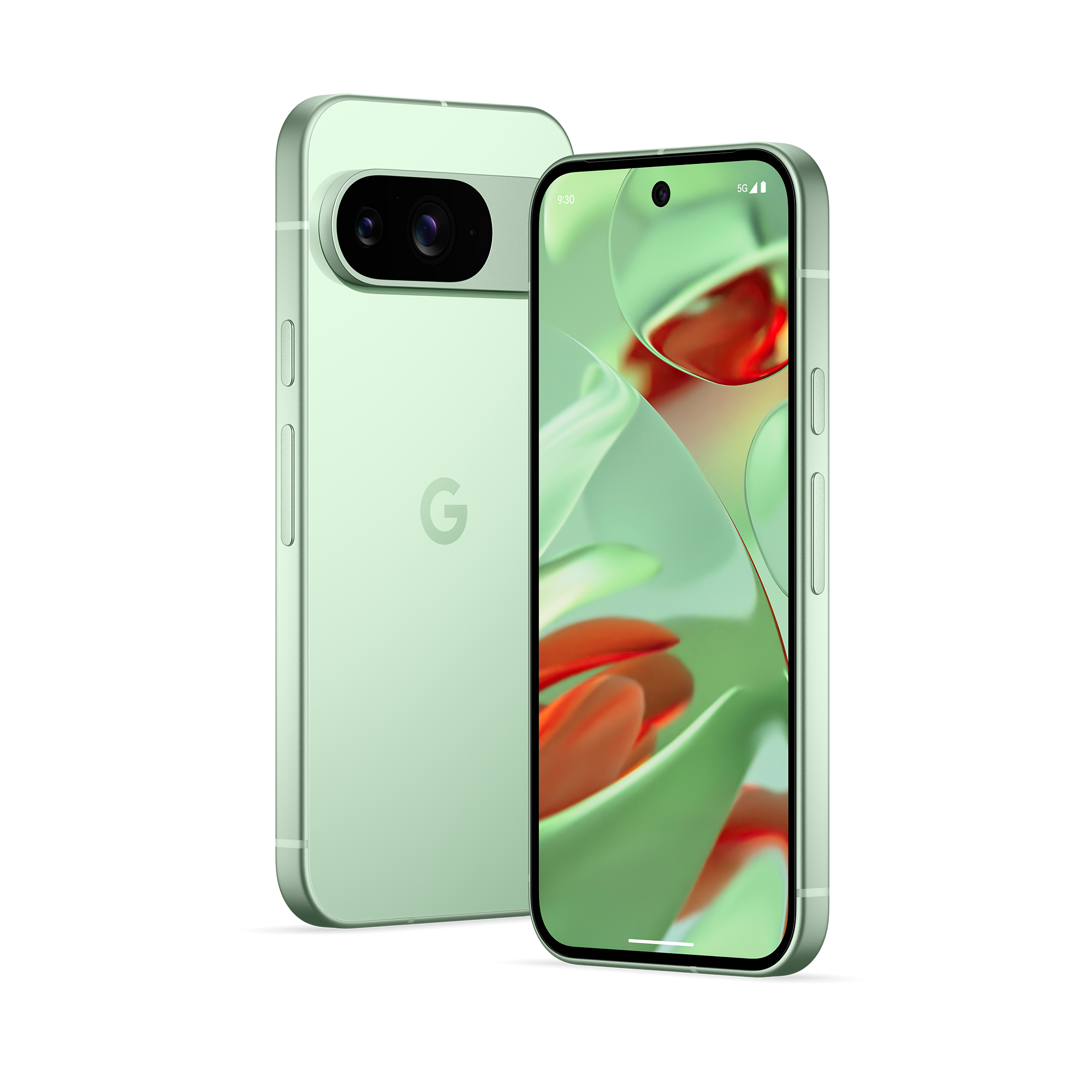
Regardless of taking delight in its software-first strategy to merchandise, Google has typically taken much less care in its efforts with show {hardware} over the previous couple of years. For readers who’ve caught round with Pixels since its early days, we all know how lackluster Pixel screens have been prior to now. However after almost a decade, Pixel customers lastly have among the greatest screens on any cellphone — even on the bottom mannequin.
For model functions, this could have been a fairly apparent transfer; if it doesn’t look fairly from the skin, many gained’t care about what’s on the within. Google’s ever-widening advertising and marketing presence and up to date refinements to the Pixel identification make it clear that the corporate is taking its picture severely — now greater than ever with the Pixel 9.

Google Pixel 9
$439 $799 Save
$360
The Pixel 9 is the bottom mannequin in Google’s 2024 lineup, boasting an upgraded 6.3-inch Actua OLED show. The display screen and digital camera are primed for HDR seize and playback, reaching a full-screen brightness of 1,800 nits with peaks as much as 2,700 nits when open air. Content material seems fluid and sharp at 120 Hz and 422 pixels per inch.
- Exceptionally vibrant and environment friendly show
- Excellent coloration accuracy in any respect brightness ranges
- Legible near-black particulars in any respect brightness ranges
- No adjustable white steadiness or calibration
- Pixel density could possibly be slightly greater for the value
- Restricted HDR10 video publicity brightness
Design and {hardware}
For the Pixel 9’s display screen form, the corners have been rounded additional, whereas the edges have been flattened out. As an alternative of two.5D glass that tapers towards the perimeters, the entrance glass is now fully flat, which I choose. The previous rounded glass typically added harsh, extraneous contours to the perimeters when gentle mirrored onto them, whereas the brand new flat panel maintains a clear and constant perimeter. When used with a display screen protector, the glass can now be made barely bigger than the display screen itself to stop rainbow refractions that may happen on the glass’ edge. And at last, the width of the chin bezel now seems to be actually symmetric with each different aspect.
Dimension-wise, the Pixel 9’s dimensions are roughly the identical as final yr, solely about 3% bigger. As a full rectangle, the Pixel 9 display screen would measure 6.29 inches diagonally, however the rounded corners carry this size down to five.97 inches. The pixel density can also be roughly the identical as final yr at 422 pixels per inch, which is decently sharp however noticeably softer in comparison with sharper screens. When you’ve got good imaginative and prescient, chances are you’ll discover gentle borders beneath black pixels, giving black-on-white textual content a considerably engraved look.

Optically, the display screen transmissivity is one of the best it’s ever been, and it’s good to see Google persevering with with versatile OLED for the bottom mannequin. In comparison with the inflexible OLED sometimes discovered on cheaper gadgets, a versatile OLED makes use of a skinny polyimide as a substitute of glass, offering superior viewing angles by decrease refraction and a slimmer show stack that raises the pixels nearer to the quilt glass and your fingertips. On our check unit, there may be little or no perceptible shift in white steadiness when seen at an angle.
This yr for panel sourcing, the Pixel 9 show is being equipped by both Samsung Show (SDC) or BOE. Our evaluate unit from Google occurs to be sourced from SDC, so my very own observations might not signify different Pixel 9 shows on the market. A couple of different show traits might differ from unit to unit as nicely, typically known as the “OLED lottery”. These embody issues like panel uniformity, viewing angles, black crush, or flickering from various refresh charges.
To seek out which vendor your Pixel 9 is sourced from, you should use an app like Machine Information HW to test your LCM driver. The Pixel 9 will both use panel-google-tk4a, panel-google-tk4b, or panel-google-tk4c. Each tk4a and tk4c are SDC panels, whereas tk4b is the BOE panel.

A better have a look at the Pixel 9’s spectral energy distribution confirms it is utilizing a distinct set of luminous OLED supplies. From the measurable spectra, we will see a barely higher-purity crimson emitter and a touch broader inexperienced emitter. The OLED pixel format nonetheless makes use of a Pentile Diamond construction, with decently massive subpixels that make up a 3rd of the whole display screen space.
Brightness and energy

Every time a brand new cellphone is launched, one of many ordinary “givens” is a brighter, higher show. However in lots of instances, this enhance in brightness isn’t ever realized in any sensible situation. Firms usually promote terribly excessive peak brightness numbers that mislead customers, since these figures are solely reached when only a few pixels on the display screen are lit up.
Within the Pixel 9’s case, Google mentions an all-new 2700 nits peak for the bottom mannequin display screen, footnoted for a 5% “on-pixel ratio” (additionally referred to as APL: common pixel stage). Because of this this new display screen can solely attain 2700 nits when 5% of the display screen is lit and the remaining is off; or extra exactly: when the typical luminance throughout the complete display screen is beneath 135 nits (5% of 2700 nits), then it might output pixels that attain its marketed peak. Sadly, this implies this marketed metric isn’t very useful, since most apps and content material will common greater than 135 nits for out of doors brightness ranges. Nevertheless, that is nonetheless higher than different firms that use peak brightness values derived from 1% APL, which is simply full nonsense and completely inflationary.

In its worst case — when the display screen is totally white, 100% APL — Google places the Pixel 9 at 1800 nits full display screen. For smartphones, this worth is commonly indicative of real-world brightness, since many light-themed apps strategy 80% APL and better. It’s an honest bump up from the 1400 nits rated on the Pixel 8, although the largest distinction is what we see at 20% APL, which is across the area of most pictures/movies when seen full display screen, encompassing house screens. Right here, we’re measuring about 2450 nits for the Pixel 9, up 31% from the Pixel 8. That is two entire generations’ value of enhancements in a single, and the distinction when open air has been apparent.
|
Full display screen |
50% window |
20% window |
5% window |
|
|---|---|---|---|---|
|
Pixel 7 |
907 nits |
1040 nits |
1157 nits |
1238 nits |
|
Pixel 8 |
1357 nits |
1721 nits |
1866 nits |
1944 nits |
|
Pixel 9 |
1735 nits |
2059 nits |
2445 nits |
2708 nits |
On prime of its a lot greater peak brightness, the Pixel 9’s throttling habits has additionally been barely tamed. Prior Pixels restricted the excessive brightness mode to 5 minutes out of each thirty minutes, and now the Pixel 9 solely wants twenty minutes to refresh its peak brightness window. When the display screen brightness throttles, it dips all the way down to a peak of 1200 nits, which continues to be extraordinarily vibrant — brighter than most telephones might even attain a yr in the past for the total display screen. The 1200 nits is no matter APL, and it’s additionally the show’s peak brightness when auto-brightness is disabled. In any other case, the display screen brightness is proscribed to 600 nits, whereas auto-brightness is on and the ambient gentle sensor reads beneath 5000 lux.
These days, most customers are often happy with their cellphone display screen’s brightness. Instead of greater brightness, many fanatics are as a substitute hoping for extra environment friendly shows and processors to enhance battery life. However sometimes, when a brand new cellphone comes out promoting an excellent brighter show, the show’s luminous efficacy wants to enhance to allocate the upper brightness inside the similar thermal finances (nicely,
apart from the Pixel 7 Professional
).
So, after all, we count on energy enhancements with the upper brightness ranges of the Pixel 9. And that’s precisely what we’re seeing:

Peak-to-peak, we’ve measured the Pixel 9 to output most show energy just like that of the Pixel 8 whereas reaching 400 nits greater. If we restrict the Pixel 9 to 1400 nits, which is the height full-screen brightness of final yr’s cellphone, the brand new show can achieve this utilizing about 1.2 watts fewer. This can be a big leap in efficacy, and shut to 2 entire generations of panel enhancements.
For indoor brightness ranges, the show isn’t often as large a consider battery, however we’re nonetheless seeing wonderful enhancements right here — not less than comparatively. In comparison with final yr, the Pixel 9 can output 100 nits utilizing solely about half the show energy. This quantities to about 155 mW, which is small however not negligible. Although total, the battery life on the Pixel 9 has typically been fairly good.

Learn our evaluate
Assessment: The Google Pixel 9 makes me query if I have to go Professional
The Pixel 9 has all the pieces most individuals need from a cellphone
We additionally see enhancements to the Pixel 9 in baseline energy, utilizing 90 mW lower than the Pixel 8 when exhibiting an all-black display screen. We don’t know the way a lot of this (if any) could be attributed to the show, but it surely’s a pleasant little bump value noting. And when ramping as much as 120 Hz, the baseline energy will increase by about 80 mW, just like what we see on different gadgets. Notice that this doesn’t issue within the further energy wanted by the CPU or GPU to ship greater framerates, which considerably varies from activity to activity.
|
60 Hz (machine energy) |
120 Hz (machine energy) |
100 nits (show energy) |
1000 nits (show energy) |
1400 nits (show energy) |
Peak (show energy) |
|
|---|---|---|---|---|---|---|
|
Pixel 8 |
480 mW |
570 mW |
315 mW |
3080 mW |
4690 mW |
4690 mW |
|
Pixel 9 |
390 mW |
470 mW |
160 mW |
2140 mW |
3470 mW |
4870 mW |
For the reason that Pixel 9 show shouldn’t be outfitted with an LTPO backplane, the display screen can’t be pushed beneath 60 Hz with out noticeable dips in luminance. The LTPS panel depends on discrete refresh fee switching between 60 Hz and 120 Hz with none granularity. Refresh fee switching additionally has a noticeable affect on colours with LTPS panels, and the brightness of darkish colours might fluctuate barely because the show switches between 120 Hz and 60 Hz when idling. The impact turns into extra pronounced in darker situations; so, to cut back the chance that it is observed, Google limits the show from decreasing to 60 Hz (if Clean Show is enabled) when the display screen brightness is beneath 10 nits.
When you’re delicate to OLED flickering, sadly, the Pixel 9 continues to make use of a pulse width modulation (PWM) frequency of 240 Hz, which may be very low by latest requirements. Each Samsung and Apple now use 480 Hz PWM on their flagship screens, and there are even some Chinese language manufacturers utilizing frequencies nicely over 1000 Hz.
Colour efficiency

With Google piloting the Android working system, the corporate has a duty to indicate content material faithfully to the creator’s intent. This requires purposeful coloration administration that considers content material metadata, together with app builders making use of the wanted APIs.
For the broad vary of media, we nonetheless largely care about sRGB/Rec.709 for pictures and movies in SDR. Show P3 can also be considerably related because it’s the colorspace by which iPhones and a few Android telephones save pictures. Latest Pixel telephones can save pictures in Show P3 as nicely, but it surely must be enabled within the digital camera settings.
However correct colours aren’t at all times what shoppers need. Many TVs, laptop screens, and Android cellphone screens come out of the field with extra vibrant colours than meant, and customers might choose this kind of image rendition. To appease this, Google Pixel telephones provide two coloration profiles, Adaptive and Pure, with the latter being the extra correct setting.
The goal tone curve is the primary distinction between the 2. Adaptive makes use of a extra standard gamma 2.2 curve, whereas Pure targets sRGB IEC: a barely flatter curve, most notably in shadows. Regardless of Pure being the extra correct mode, it could look much more washed out than ordinary because of the curve it makes use of — the dialogue of which curve is extra appropriate could be considerably political, so I’ll attempt to abstain from that matter regardless that gamma curve is the precise choice.

By default, the Pixel 9 makes use of the Adaptive coloration profile, yielding barely extra vibrant colours. Nevertheless, with each passing era, it appears Google reduces Adaptive’s saturation to the purpose the place it could not appear all too totally different from Pure. At a medium brightness stage of 100 nits, the Pixel 9’s Adaptive mode measures a mean coloration error ΔEITP of 4.9, which I’d say leans extra towards correct than not. Nevertheless, there are a few most errors that exceed a ΔEITP of 10, as much as 14, largely for boosted inexperienced colours. The mode appears shy in boosting crimson and orange colours, prone to protect pores and skin tone accuracy.
In grayscale, the Pixel 9’s tone copy is virtually good. The Adaptive mode is pinpoint correct to gamma 2.2, even down at a sign stage of 1.25%. The show doesn’t undergo any black clipping, confidently producing the primary 8-bit step out of black at any brightness stage.
White steadiness calibration on our Pixel 9 unit tends to be slightly cooler than our 6500 Ok goal, however not by a lot. Total, white steadiness errors are nonetheless very low all through the show’s brightness vary, together with negligible variance in grayscale tinting. This implies the Pixel 9’s white steadiness seems constant no matter show brightness. Nevertheless, I nonetheless would love Google so as to add changes for white steadiness RGB to accommodate customers who need or want totally different tuning.
|
White Steadiness |
Luminance Error |
Colour Error |
Colour Luminance Error |
|
|---|---|---|---|---|
|
Min. Brightness |
6493 Ok / ΔEITP = 1.3 ± 2.3 |
ΔPQ = 1.1 (avg) / 2.9 (max) |
ΔEITP = 1.4 (avg) / 5.3 (max) |
ΔPQ = 0.7 (avg) / 2.5 (max) |
|
Low Brightness |
6564 Ok / ΔEITP = 1.0 ± 1.6 |
ΔPQ = 1.7 (avg) / 4.5 (max) |
ΔEITP = 1.7 (avg) / 4.1 (max) |
ΔPQ = 0.7 (avg) / 2.3 (max) |
|
Medium Brightness |
6759 Ok / ΔEITP = 1.4 ± 2.1 |
ΔPQ = 1.2 (avg) / 4.3 (max) |
ΔEITP = 2.2 (avg) / 5.4 (max) |
ΔPQ = 1.1 (avg) / 2.6 (max) |
|
Excessive Brightness |
6657 Ok / ΔEITP = 1.4 ± 1.2 |
ΔPQ = 1.2 (avg) / 4.3 (max) |
ΔEITP = 2.4 (avg) / 8.6 (max) |
ΔPQ = 2.8 (avg) / 5.9 (max) |
|
Max Auto-Brightness |
6698 Ok / ΔEITP = 1.2 ± 1.3 |
ΔPQ = 88 (avg) / 123 (max) |
ΔEITP = 4.0 (avg) / 10 (max) |
ΔPQ = 26 (avg) / 59 (max) |
Colour accuracy has at all times been one of many Pixel’s robust fits. In its Pure coloration profile, the Pixel 9 measures extremely precisely, averaging a coloration error ΔEITP of about 2.2 in medium brightness, with a most coloration error ΔEITP of 5.4. This is applicable to sRGB and Show P3 content material, which the Pixel 9 correctly coloration matches in Google Pictures. Usually, a ΔEITP worth beneath 3.0 is indistinguishable from good until you’re educated to see the distinction in essentially the most delicate situations.
In tone response, the Pure mode has an excellent low common luminance error ΔPQ of 1.2 when measured in opposition to the sRGB IEC curve. I’d have strongly most popular it if Google used gamma 2.2 as a substitute. Or dare I say, add an choice to decide on.
When the auto-brightness detects daylight, the show closely boosts the lightness of mid-tones and shadows to maximise display screen visibility open air. Colour saturation can also be barely boosted to fight in opposition to gamut discount that happens with robust display screen glare.
HDR efficiency
Onward from the Pixel 7, Google reworked the show HDR pipeline, enabling media to output specular highlights at as much as 8× the present display screen brightness for a extra true-to-life HDR expertise. This impact is critical for HDR content material — akin to these captured by the Pixel digital camera’s
Extremely HDR photograph
or 10-bit HDR video — so that they are proven on the correct brightness stage. The Pixel 9 show is specced to succeed in as much as 1800 nits for HDR, which we have verified with brightness measurements, that means that highlights can attain this peak when the bottom brightness is not less than 225 nits (from the 8:1 HDR-to-SDR ratio).
For HDR10, which makes use of a separate container for each coloration gamut and tone response (BT.2020 with ST.2084), content material is solely re-mapped onto the bottom SDR calibration of the panel (P3-D65 with gamma 2.2). So, if the bottom calibration tracks SDR precisely (which it does very nicely), implicitly the HDR10 copy also needs to be correct, and fortunately, that is precisely what we see.
|
White Steadiness |
Luminance Error |
Colour Error |
Colour Luminance Error |
|
|---|---|---|---|---|
|
Low Brightness |
6579 Ok / ΔEITP = 2.3 ± 4.5 |
N/A (deliberately dimmer than reference) |
ΔEITP = 2.5 (avg) / 7.1 (max) |
ΔPQ = 1.2 (avg) / 3.6 (max) |
|
Medium Brightness |
6544 Ok / ΔEITP = 1.5 ± 3.2 |
ΔPQ = 1.2 (avg) / 17 (max) |
ΔEITP = 3.4 (avg) / 9.8 (max) |
ΔPQ = 2.9 (avg) / 6.1 (max) |
|
Excessive Brightness |
6584 Ok / ΔEITP = 1.5 ± 3.2 |
ΔPQ = 5.3 (avg) / 13 (max) |
ΔEITP = 4.8 (avg) / 15 (max) |
ΔPQ = 2.8 (avg) / 5.8 (max) |
Regardless of having an correct response, a significant recurring downside with viewing HDR10 media is that its customary tone curve makes use of absolute luminance values. Because of this a show completely reproducing this curve has one and just one brightness setting, and changes to the brightness slider would have zero impact. It would make sense for a house theater system, however not for a cellphone — a tool that should adapt to many alternative lighting situations.
Pixel telephones use a hybrid strategy, scaling HDR10 video publicity with display screen brightness, however solely as much as the usual reference stage. Nevertheless, for many HDR10 content material, the typical scene brightness correlates to an SDR white stage of about 100 nits, which is commonly too dim in a brighter room. Many different Android telephones undergo from this basic playback downside, and it is grow to be a standard criticism that reveals seem too darkish on streaming platforms. Moreover, Pixels waste a great chunk of their brightness headroom by at all times tone mapping towards 4000 nits; it clearly cannot attain these ranges, however it is going to compress its higher brightness vary to attempt to accommodate movies or films that decision for 4000 nits, even in the event you’re watching one thing which may solely require 1000 nits.
The decision

If there was any doubt about Google’s newfound {hardware} engagement, the Pixel 9 ought to extinguish all of them — not less than for the show. The Pixel 8 already had a fairly nice display screen, so it caught me fully off-guard seeing two generations’ value of OLED emitter upgrades within the Pixel 9. It is not your ordinary kind of year-over-year enchancment — particularly two years in a row — and it is good to know that Google is lastly sourcing one of the best shows doable. The cellphone did see one other slight bump in worth, but it surely has the appear and feel to again it up, and the display screen to seal the deal.
In fact, it is not with out flaws, and there are options competing telephones have that the Pixel 9 would not. The iPhone 16 has a sharper display screen and True Tone, the Samsung Galaxy S24 has an LTPO show (plus True Tone), and Xiaomi telephones have DC dimming and coloration tuning — in addition to True Tone. However that does not low cost the truth that Google is doing what it does fairly rattling nicely with its shows, which isn’t one thing I’ve at all times been in a position to say, although I certain do hope I get to maintain on doing so.

Google Pixel 9 Professional
The Pixel 9 is the bottom mannequin in Google’s 2024 lineup, boasting an upgraded 6.3-inch Actua OLED show. The display screen and digital camera are primed for HDR seize and playback, reaching a full-screen brightness of 1,800 nits with peaks as much as 2,700 nits when open air. Content material seems fluid and sharp at 120 Hz and 422 pixels per inch.
